


Cagrilintide: A Novel Amylin Analogue Reshaping Obesity Therapeutics
Cagrilintide represents a significant advancement in the pharmacological armamentarium against obesity, a chronic disease with profound global health and economic implications. Developed by Eli Lilly and Company, this long-acting amylin analogue leverages a distinct biological pathway to induce weight loss, offering new hope and potential combination strategies.
Products Description
-Molecular Identity: Cagrilintide is a synthetic, acylated peptide analogue of human amylin (also known as islet amyloid polypeptide, IAPP). Amylin is a naturally occurring peptide hormone co-secreted with insulin by pancreatic beta-cells in response to food intake.
-Mechanism Class: It belongs to the class of amylin receptor agonists, specifically mimicking the actions of endogenous amylin. Its primary targets are receptors in the hindbrain (notably the area postrema), distinct from the GLP-1 receptor targets of drugs like semaglutide or tirzepatide.
-Pharmacokinetic Profile: Engineered for once-weekly subcutaneous administration, cagrilintide features a prolonged half-life achieved through reversible albumin binding (facilitated by its fatty acid side chain). This structural modification significantly extends its duration of action compared to native amylin.
-Development Status: While extensively studied in clinical trials, particularly in combination therapy (see below), cagrilintide itself is not currently approved as a standalone medication by major regulatory agencies (FDA, EMA). Its primary pathway to market is as part of fixed-dose combination products.
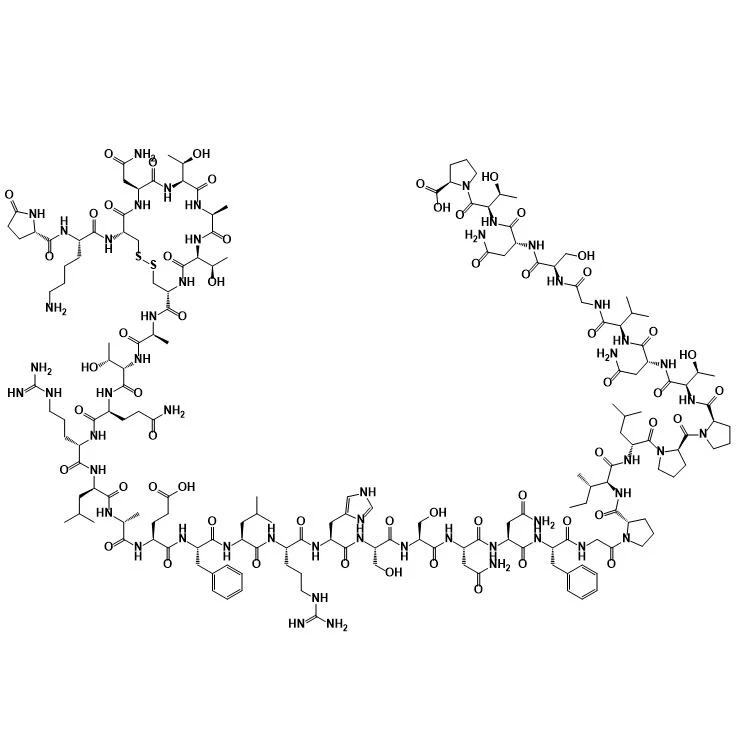
Cagrilintide Benfits:
Cagrilintide exerts its weight-loss effects by modulating central nervous system pathways controlling appetite and energy homeostasis:
1.Reduced Food Intake via Enhanced Satiety: Its primary mechanism is promoting feelings of fullness (satiety) and reducing hunger. It achieves this by:
Slowing Gastric Emptying: Similar to GLP-1 agonists, it delays the rate at which food leaves the stomach, contributing to prolonged feelings of fullness after meals.
Central Appetite Suppression: Crucially, it acts directly on amylin receptors in the hindbrain (area postrema and nucleus tractus solitarius), key regions regulating satiety and nausea. This central action potently reduces appetite and overall calorie intake.
2.Weight Loss Efficacy: Clinical trials have demonstrated significant weight loss with cagrilintide, both as monotherapy and, more robustly, in combination:
Monotherapy (Phase 2): The 26-week phase 2 trial showed dose-dependent weight loss (up to ~10.8% placebo-adjusted) at the highest dose (4.5 mg) in individuals with overweight or obesity.
Combination Therapy (Phase 3 - SURMOUNT-CBP): The most compelling data comes from combining cagrilintide with GLP-1 receptor agonists. The landmark SURMOUNT-CBP trial investigated CagriSema, a fixed-dose combination of cagrilintide (2.4 mg) and semaglutide (2.4 mg). Results were striking: participants achieved mean weight reductions of approximately 24% after 52 weeks, significantly exceeding results seen with either component alone (semaglutide ~16%, cagrilintide ~8%).
3.Potential Metabolic Benefits: While weight loss is the primary endpoint, improvements in associated cardiometabolic parameters like blood pressure, lipids, and glycemic control (in individuals with type 2 diabetes) have been observed, consistent with significant weight reduction.

Cagrilintide Application Market
1.Obesity Market: This is the core target. The overwhelming success of CagriSema in phase 3 trials positions it as a potential best-in-class therapy for chronic weight management upon anticipated approval (expected ~2026). It targets adults with obesity (BMI ≥30 kg/m²) or overweight (BMI ≥27 kg/m²) with at least one weight-related comorbidity (e.g., hypertension, T2D, dyslipidemia, obstructive sleep apnea). Its significantly higher efficacy profile (~24% weight loss) directly challenges current market leaders (semaglutide ~16%, tirzepatide ~21-23%).
2.Type 2 Diabetes Market: While tirzepatide (GLP-1/GIP) dominates glycemic control and weight loss in T2D, CagriSema offers a potent alternative, particularly for patients needing maximal weight reduction alongside glucose control. Lilly is likely to pursue this indication.
3.Market Dynamics:
Competitive Landscape: Direct competition with Novo Nordisk's semaglutide (Wegovy/Ozempic) and Lilly's own tirzepatide (Zepbound/Mounjaro). CagriSema aims to capture market share by offering superior weight loss efficacy.
Pricing & Reimbursement: High cost remains a significant barrier for obesity pharmacotherapy. Superior efficacy may strengthen the value proposition for payers, but reimbursement hurdles will persist. Pricing relative to tirzepatide will be crucial.
Patient Segmentation: Likely positioned for patients needing >15-20% weight loss or those with inadequate response to existing GLP-1 monotherapies.

Future Three-Year Trends (2025-2028)
The next three years will be pivotal for cagrilintide and its combinations:
1.Regulatory Approvals (2025-2026): The primary focus is securing FDA and EMA approval for CagriSema (cagrilintide + semaglutide) for obesity and potentially type 2 diabetes, based on the robust SURMOUNT-CBP data. This is the most immediate and significant milestone.
2.Market Launch and Uptake (2026-2027): Successful launches in major markets (US, EU, Japan). Initial uptake will depend on manufacturing capacity (overcoming current GLP-1 agonist supply constraints), formulary access, pricing, and physician/patient education highlighting its superior efficacy profile.
3.Expansion into Cardiometabolic Indications: Leveraging significant weight loss, trials exploring impact on obesity-related comorbidities like NASH/MASH, heart failure with preserved ejection fraction (HFpEF), and cardiovascular risk reduction (beyond weight loss itself) are likely. Positive data could significantly expand the market.
4.Exploration of Other Combinations: While CagriSema is the lead, Lilly may explore other combinations (e.g., cagrilintide + tirzepatide - "Tirzecagril"?) seeking even greater efficacy, though development cost and cannibalization are considerations. Combination with non-peptide agents is also possible.
5.Oral Formulation Development: Lilly is actively pursuing oral versions of its peptides. An oral formulation of a cagrilintide combination (even if bioavailability is lower) would be a major competitive advantage, significantly improving convenience and accessibility. Early-phase trials for oral CagriSema components are underway.
6.Competitive Response: Expect intensified competition from Novo Nordisk (next-gen GLP-1s, oral formulations, combinations like CagriSema) and other players (e.g., Amgen's AMG 133 - GLP-1/GIP bispecific, Pfizer's danuglipron - oral GLP-1).
7.Real-World Evidence Generation: Post-approval studies will monitor long-term safety, durability of weight loss, impact on hard cardiovascular outcomes, and effectiveness in diverse real-world populations outside clinical trials.


